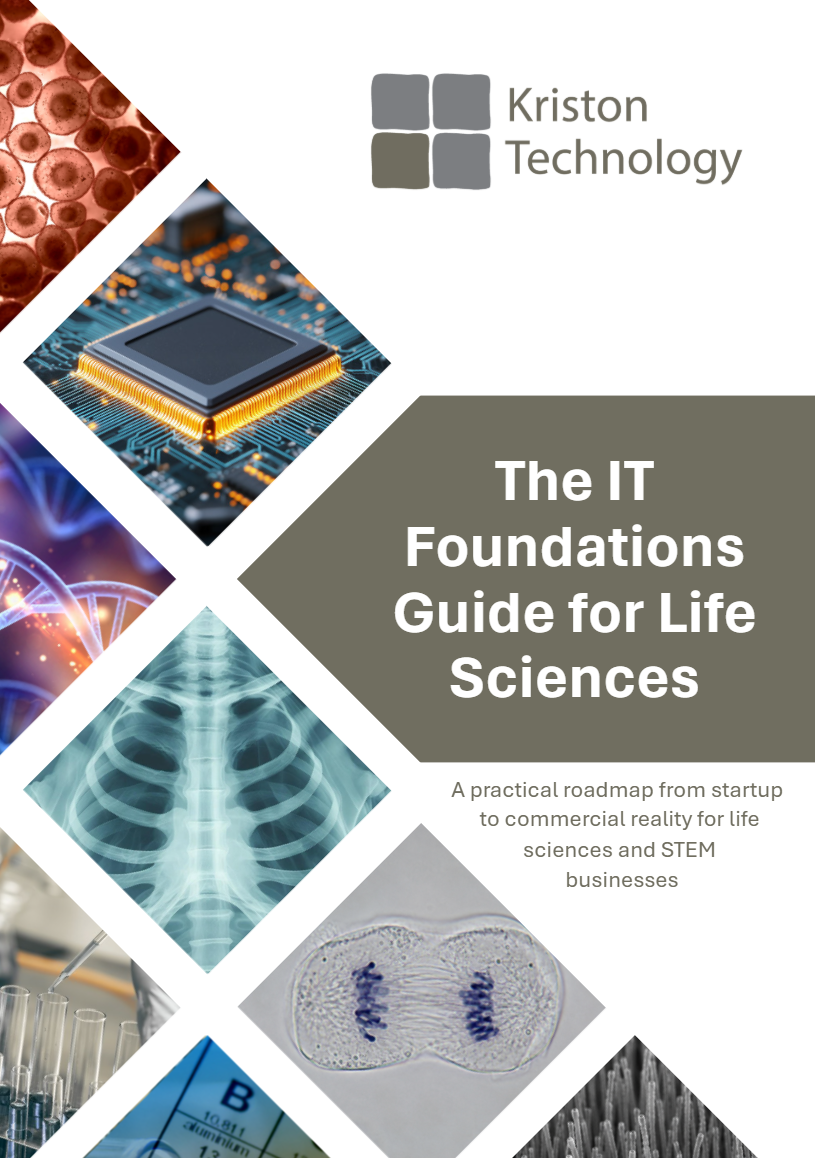
A practical roadmap from startup to commercial reality for life sciences and STEM businesses.
Get the foundations right early and you avoid the growth pain that catches so many promising teams out: messy permissions, shadow IT, security gaps, and fire fighting just as fundraising, partnering, or an audit kicks off.
Written for founders, operations directors, and lab managers of life sciences and STEM businesses, from the earliest stage up to around 50 people.
32 pages, free, and we do not ask for your email.
No form, no follow up sequence.
Everything in one place
The guide, the two template documents it refers to, all in one place. All free, all without a form.
Already have the printed guide? The two templates below are the ones referred to on page 24.
The IT Foundations Guide
The full 32 page guide, covering the three foundations, the things that break first, the spin out and lab realities most guides, and a roadmap for what to do in what order.
Ownership map template
Who is responsible for devices, Microsoft 365, backups, security, suppliers, and budgets. The first of the two documents referred to in Chapter 7.
Maintenance checklist template
A two page checklist of what gets checked week, monthly, quarterly and annually. Removes most of the dependence on one persons memory.
It is Tuesday, and the lab is busy
A sample run is part way through on an instrument that has not been restarted in months. A new research assistant started this morning and needs access to the shared drive, the electronic lab notebook, and the analysis software, ideally before lunch. A collaborator has emailed asking how you keep their data secure, and needs a proper answer. Someone’s laptop will not connect to the Wi-Fi in the write up room.
Nobody in that moment is thinking about whether last night’s backup ran, who still has access to what, or how out of date the software on the instrument PC has become.
Those questions tend to surface at the worst possible time: during due diligence, mid audit, or the morning something stops working.
The good news is that you do not need to understand IT deeply to stay ahead of the issues. You need to know the right questions to ask, have a basic picture of what your systems are doing, and have the parts you cannot see looked after properly.
The IT that was fine for five people in one room starts to creak at exactly the moment you cannot afford it to.
Who it is for
What is inside
Nine short chapters and a plain English glossary. No jargon that is not explained, and no shopping list of tools.
01 IT beyond the lab bench
Why IT ownership happens by accident in early teams, and what changes when the science starts moving towards commercial reality.
02 The three foundations
Scalability, compliance, and security, and why they pull in the same direction more often than not.
03 Why this is a commercial issue, not an IT one
Less friction day to day, confidence in due diligence, reduced risk, and better continuity.
04 The things that break first
Nine patterns we see most often in growing teams, and what good looks like in each case.
05 The spin out and lab realities most guides miss
Separating cleanly from a parent institution, instrument PCs, research data at scale, and where your data actually lives.
06 A foundations self check
Twenty two questions an investor, auditor, or careful customer is likely to ask.
07 Where to start: a foundations roadmap
Six steps in a sensible order, and the two to do first if you do nothing else this quarter.
08 When to bring someone in
The point at which a partner earns their place, and six questions worth asking any prospective one.
09 What to do next
Plus a plain English glossary of every term used.
The three foundations
Life sciences and STEM startups share a few realities that shape everything else: rapid growth, sensitive intellectual property, and higher expectations around governance and being able to prove what you say.



Scalability: built for growth
Compliance: ready for scrutiny
Security: protecting your core assets
Systems that grow with you without constant disruption. The goal is for growth to be a configuration change, not a crisis.
Being able to demonstrate that systems and data are managed properly, rather than saying you think they are. Being almost compliant tends to be the expensive and stressful version.
Reducing the chance of an incident and limiting the impact if one happens. Something credible you can put in front of customers as a differentiator, and in front of investors for peace of mind.
These three pull in the same direction more often than not. Build for scale sensibly and you tend to make compliance and security easier at the same time.
How do your foundations stand up?
Chapter 6 is a self check: twenty two questions across identity and access, devices, data and collaboration, backup and recovery, compliance and evidence, and network and tools. They are not a sales test. They are the questions an investor, auditor, or careful customer is likely to ask, and the ones worth being able to answer for your own peace of mind.

When someone leaves, is their access removed the same day?
Has a restore actually been tested, rather than assumed?
Could you answer a security questionnaire today without a scramble?
Have you agreed what data is and is not allowed near AI tools, and does everyone know?
If a few of those gave you pause, that is normal at this stage, and useful to know. It is much easier to address now than during a funding round or audit.
Who wrote this
I am Carl Gray, Technical Director at Kriston Technology.
Behind every scientific breakthrough is a business that has to run day to day, and that includes the unglamorous part: reliable, well managed IT. It’s what we have been doing for life sciences and STEM businesses since 1998, across Oxfordshire and London, and remotely throughout the UK.
We hold ourselves to the standards set out in the guide. Kriston is certified to Cyber Essentials Plus and IASME Cyber Assurance Level Two, and we run a quality management system certified to ISO 9001, so none of what follows is theory for us.

Carl Gray
Technical Director, Kriston Technology
What our clients say
We’re proud to be the trusted IT support partner for numerous life sciences and STEM businesses across Oxfordshire, London and the UK. Here’s what our clients say:

“Kriston Technology are an integral part of the team: their support is always available when we need it and to the highest standard. Their broad expertise across all aspects of IT and digital security has been invaluable to the company.”
Robin Cohen
Chief Executive Officer


“We operate in an industry that thrives off agility. Kriston Technology have grown with us and adapted their services to our needs. What started out as IT support on a shoestring budget has evolved into a flexible and proactive strategic partnership as our business has grown and flourished.”
Sarah Clare
SVP, Finance and Operations


“We simply don’t have IT issues – that’s because Kriston Technology manage our IT.”
David Churchman
Founder and Managing Director


“Kriston Technology’s expertise and dedication were instrumental in achieving our Cyber Essentials renewal. Their thorough approach and attention to detail have significantly enhanced our security posture and provided our customers with the confidence they need.”
Clare Simpson
Head of Operations

A second opinion on where things stand
If you would like a second opinion on where your foundations stand, the simplest next step is a short, no obligation conversation. Book a 15 minute video call with me and we can talk through where you are, what is worth doing first, and anything to be aware of as the business grows.
There is no obligation to buy anything, and plenty of founders take the call and act on it themselves. That is fine by me.
A short review typically covers
- Data storage and backup
- Device and software support
- Access control and remote access security
- System resilience
Often the outcome is a few small improvements. Sometimes it just confirms your foundations are already solid.
If you would like to know more
IT support for life sciences
An Expert IT services for life sciences, STEM, pharmaceutical, biotechnology, and clinical research companies. Supporting research led businesses in the Oxford to Cambridge corridor since 1998.
IT support for startups and spin-outs
Secure and scalable IT for early stage companies moving fast, including clean separation from a parent institution.