Artificial intelligence is quickly becoming part of everyday business technology. From writing and research to administration, data analysis and customer support, AI tools are helping organisations save time, improve efficiency and make better use of their people’s skills.
But successful AI adoption in the workplace is not just about choosing the right tools. For businesses to see real productivity gains, employees need the confidence, training and guidance to use AI safely, responsibly and effectively.
In this guide, we explore why AI confidence matters, how businesses can support employees, and what practical steps can help organisations get more value from workplace AI.
Why AI adoption in the workplace is growing
AI adoption is accelerating across UK businesses as organisations look for smarter ways to manage workload, streamline processes and improve productivity. Research from the British Chambers of Commerce found that more than half of UK firms are now actively using AI, showing how quickly the technology is moving from experimentation into day-to-day operations.
For many teams, AI assistants are already helping with content creation, meeting preparation, reporting, planning and repetitive administrative tasks. Used well, these tools can free up valuable time and allow employees to focus on higher-value work.
However, increased use does not automatically mean employees feel confident. Some people are excited by the possibilities, while others are unsure when to use AI, how much to rely on it or whether using it will be viewed positively by colleagues and managers.
Why employee AI confidence matters
Employee confidence is one of the most important factors in successful AI implementation. If staff feel uncertain or unsupported, they are less likely to experiment, share useful examples or develop the digital skills needed to make AI part of everyday working life.
AI should support people, not replace their judgement. The most effective businesses use AI as a productivity tool that helps teams work faster, think differently and improve the quality of their output while keeping human oversight at the centre of decision-making.
AI training helps businesses use technology responsibly
Many organisations still expect employees to work out AI tools for themselves. While experimentation can be useful, it is not a substitute for proper AI training. Teams need practical support that explains what AI can do, where its limitations are and how to check outputs for accuracy, privacy and quality.
Clear guidance is especially important when confidence levels vary across a business. Leaders and managers may be ready to explore new tools, while other team members may need reassurance, examples and a clear understanding of what responsible AI use looks like.
How to create a responsible AI culture at work
To get the best return from AI tools, businesses need to create a culture where using AI is seen as smart working, not cutting corners. Encourage employees to talk openly about how they are using AI, what is working well and where they still need support.
Practical steps can include internal workshops, approved AI use cases, clear policies, cyber security guidance and opportunities for teams to demonstrate how AI is helping them work more efficiently. This gives employees permission to learn while helping the business maintain control and consistency.
AI confidence will not happen overnight. But with the right training, culture and IT support, your team can use AI in ways that improve productivity, strengthen digital skills and prepare your organisation for the future of work.
AI confidence checklist for employees
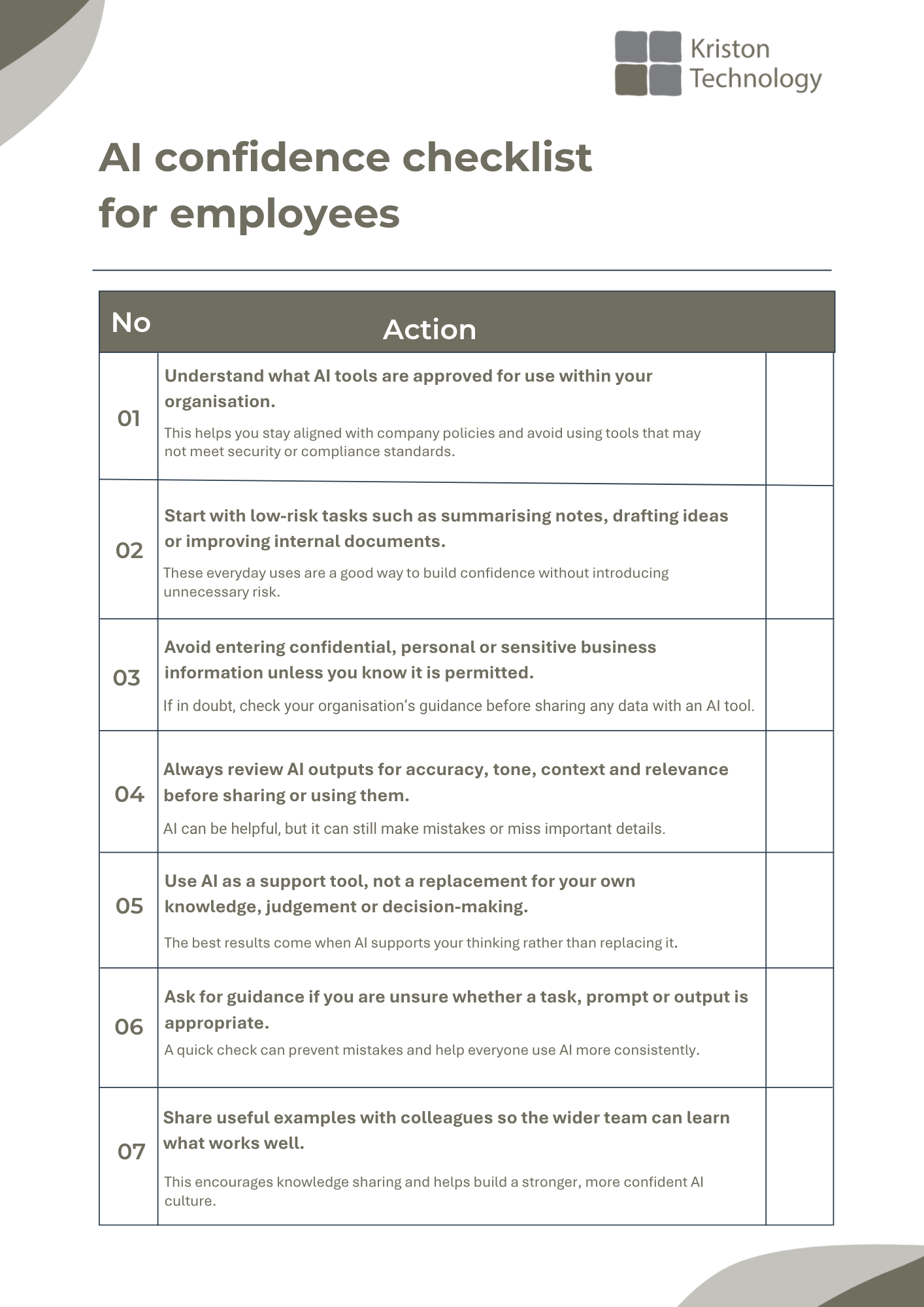
From an employee perspective, building confidence with AI starts with small, safe and practical steps. This checklist can help team members understand how to use AI tools responsibly while keeping quality, privacy and human judgement at the centre of their work.
- Understand what AI tools are approved for use within your organisation.
- Start with low-risk tasks such as summarising notes, drafting ideas or improving internal documents.
- Avoid entering confidential, personal or sensitive business information unless you know it is permitted.
- Always review AI outputs for accuracy, tone, context and relevance before sharing or using them.
- Use AI as a support tool, not a replacement for your own knowledge, judgement or decision-making.
- Ask for guidance if you are unsure whether a task, prompt or output is appropriate
- Share useful examples with colleagues so the wider team can learn what works well.
Need help with AI adoption and digital transformation?
Kriston Technology helps businesses make better use of technology with practical IT support, cyber security guidance and digital transformation advice. If your organisation is exploring AI tools, now is the time to put the right training, policies and support in place.